Last night, as I was leaving my Arabic lesson, a young boy (maybe 14 max?) walked past me on dark and reasonably lonely pavement. As he approached me, he leant in and whispered something into my ear. He also grabbed my arm for a split second. I didn't understand what he whispered, but it was threatening and intimidating and certainly wasn't meant to be a pleasant experience for me.
I walked home and fumed (and occasionally cried) for the next 40 minutes. Why would such a young boy feel entitled to intimate and harass me in this way? What on earth is his view of women (and, of course, Western women in particular)?
I was wearing many layers of clothing that covered my arms and legs. I had on a pair of trainers and a coat that was buttoned to my neck (I was kind of hot, actually!). So I was not "on display" in any way... (just in case anyone thinks I might be to blame...)
As this blog makes clear, I am deeply saddened by the way women are treated in this society. As a liberated, strong, free woman, I feel that I am being pressurised every day to be meek and to cover myself and to stare at the floor. Ideally, it seems, I wouldn't leave the house.
One person has told me that I am a guest in this society and should leave if I don't like the customs. But this isn't "custom." This is a social outlook that encourages even young boys to threaten and subdue the women that pass them on the street.
I do not believe that society in the US or the UK is perfect. And I am not 'bashing' every aspect of the Muslim world or claiming that there is true equality between the sexes in any other country. But I am angry and dismayed and horrified at the deep-seated and very public sexism in this society. Even if the Quran does call for a 'barrier' between the sexes, this barrier should also be respected by men. The men, as much as the women, should lower their gaze and not intrude into a woman's personal space. They should keep their sexuality in check in public spaces. Here, men's actions towards women are tinged with violence and are intended to continually underline male supremacy. I feel strangled and it is a fight for me every day to not become subdued and a little defeated.
I do not care what women wear. I do not care if the sexes never look each other in the eye. But I do care that women are continually threatened in the street, are completely absent from political positions (Egypt was ranked 130 out of 134 countries in the "Women in Parliament" rankings, 2005: http://www.ipu.org/wmn-e/arc/classif300906.htm), and that educational opportunities and even health care are nowhere near as readily available to women as to men (see World Economic Forum rankings on women's equality in Egypt at http://www.weforum.org/pdf/Global_Competitiveness_Reports/Reports/gender_gap.pdf. Women's empowerment is ranked from 7 (highest) to 1 (lowest) and Egypt comes near the bottom at 2.38 out of 7).
I do not want one societal model that is implemented around the world. I value the differences that exist from culture to culture, including the degree to which religion is integrated into political and legal life. I accept the principle of modest dress and behaviour, as long as it is demanded of men as much as women. But sexual inequality and a culture of aggression towards and repression of women should be eliminated in every society. I feel in Egyptian society that there is a long way to go.
I am angered when I am living in the UK and US because I am very aware of the gender discrimination and 'glass ceilings' that still exist. As a woman, I face extra hurdles when I contemplate how to balance a career and children. I have to continually assess whether, if I choose to wear makeup or shave my legs, I am bowing to masculine desires and demands. I have to consider why I always feel the need to lose another few pounds in weight. But my anguish in those societies can't match the anger that I feel living in this society where I am physically and mentally assaulted by men every single day.
Showing posts with label Egypt. Show all posts
Showing posts with label Egypt. Show all posts
Wednesday, 21 November 2007

Monday, 12 November 2007
EIPR/ HRW report on denial of religious freedom in Egypt
Today, EIPR published its joint report (with HRW) on the persecution of Baha'is within Egypt. This report is an excellent account of the way in which the Egyptian government denies freedom of religion within Egypt. Basically, all national ID cards (cards that are essential for routine activities such as enrolling in university, acquiring a driving license, travelling, drawing a pension etc...) require that the individual declares his or her religion. There are only 3 religions that can be selected: Muslim, Christian and Jew. There is no option for a blank. This means that the Bahai community in Egypt is denied basic rights and discriminated against in a terrible manner. Also, individuals who convert from Islam to Christianity face charges of apostasy and are denied the ID cards.
There was an impressive press conference held at our office today, with a range of foreign and Egyptian journalists. I was happy to see a report on the BBC website this evening:
http://news.bbc.co.uk/2/hi/middle_east/7091412.stm
There was an impressive press conference held at our office today, with a range of foreign and Egyptian journalists. I was happy to see a report on the BBC website this evening:
http://news.bbc.co.uk/2/hi/middle_east/7091412.stm
Friday, 9 November 2007
Storefront IV: Guns and Black-Clad Security Forces

 This was definitely my favourite shop for today! As I was walking in the downtown area, I passed this gun shop. My heart was warmed at the thought of guns being handed out over the counter -- I felt like I was back in the US! Particularly reassuring was the fact that I turned the corner and saw three black Egyptian security-force trucks parked on the street.
 The photographs are a little dark, but I hope you can just make out the faces of the security forces staring out through the small barred truck windows. Big police and security force trucks just like this seem to be parked everywhere and, if you look up at them, you see dozens of pairs of eyes staring down at you from behind barred windows.
One little aside on the black-clad security forces (compared with the white-clad police). The men who serve in the security-forces are conscripted from the poorest sections of Egypt (where people live on less than $1 a day). They have to leave their families and come to live in Cairo for three years. They live in camps on the outskirts of the city where conditions are reported to be terrible. Whenever there are demonstrations or civil discontent, it is usually these security forces who are ordered to come in and beat up the citizens - they get all the government's dirty work...
Thursday, 8 November 2007
An audience of dissatisfied African men
 Last night, November 7, I went to a talk at AU on “Crossing the Border: Palestinians, Migrants and Bedouins in Sinai.” The speaker described the complex layers of cultures and ethnic groups that live and move through this section of Egypt. There were, she said, four principal groups: 1) Palestinians; 2) Bedouins; 3) Egyptian migrants; and 4) Illegal migrants.
The speaker described the thousands of Palestinians that have been trapped at the border at Rafah since Hamas took control of Gaza strip. A new word, she said, has emerged in the Palestinian dictionary to describe these people: “al-Alqyin”, or “the stranded.” She explained how the Bedouins, who had lived in this section of the world for generations, lacked basic legal rights such as property rights and citizenship. She outlined how the Egyptian government repopulated Sinai after 1982, drawing villagers from the Egyptian valley over to Sinai with promises of better salaries and housing.
But what struck me about the whole talk was not all this fascinating information about Palestinians, Bedouins and Egyptian migrants. It was the makeup of the audience who had come to listen to the talk. Over 75% of the people sitting in the room were African men. I have no idea where these men were from. I have no idea whether they are living in Egypt legally or illegally. But they did seem particularly fascinated by the topic of “illegal migrants.” Unfortunately, the speaker only brushed over this topic in the last minute of her 40-minute presentation. Knees jiggled nervously around me. When the speaker stopped, these men questioned her about the smugglers who traffic people across the border from Egypt to Israel: Was it just the Bedouins? Who was in overall control of this smuggling? Who controlled the border? The speaker’s answers were wholly inadequate (to be fair, this wasn’t her focus..)
I could only imagine what was passing through these men’s minds. Maybe I’m projecting stories onto them – maybe none of them have any intention of attempting to cross the border through the desert mountains. But it is likely that Israel is a potential destination for at least some of the men, despite the fact that Sudanese and Eritrean refugees have recently been shot by the Egyptian police as they were crossing the border, and despite the fact that Egypt has declared it is planning to return to Sudan some Sudanese refugees sent back from Israel (in violation of international refugee law). (see http://www.reliefweb.int/rw/rwb.nsf/db900sid/EMAE-78FM49?OpenDocument; http://fortresseurope.blogspot.com/2006/01/three-migrants-shot-dead-in-2007-at.html).
When the speaker described the harsh conditions, the dangerous mindsets of the security force policing the border, and the rise in the use of violence in that region of the world… I couldn’t help but wonder if this was making at least some of the men’s hearts jump. I felt deeply grateful that I didn’t have to face this type of arduous journey in the quest for peace and economic opportunity.
"Manifesto of a Veiled Woman"
At the “women in cyberspace” conference that I went to at AU on Monday night, Mona Eltahawy’s young sister told a wonderful story about the preconceptions that surround women who choose to wear the veil. Mona’s sister (whose name I didn’t catch – I will call her Laura, because that’s my sister’s name!) has decided to wear the hijab. She stated that veiled women in Egypt walk a tight line: the fundamentalists don’t like these women (they aren’t covered enough) and the liberals want to save every one of them. Laura described how, one day at college, she wanted to fill in a questionnaire on the topic of beauty. So she asked for a copy of the questionnaire and was told that veiled women were not allowed to fill it out. This led Laura to use her facebook account to vent her frustration. On facebook, she published her “manifesto of the veiled woman.” This manifesto included statements such as 1) I have sexual desires like any other woman/person; 2) I care about beauty. Laura said that she was sick and tired of being viewed as a vegetable.
Before long, she received a message from an Egyptian man who clearly could not cope with this open expression of sexual desire. Egyptian man told Laura that she was “a danger to society.” Egyptian men, he declared, did not want to marry women like this so Laura would have to (quote) “turn to homos.” Laura promptly blocked this charming man from her facebook account. But she made a final telling remark: cyberspace provided her with a relatively safe space to express her desires and individuality. And she was able quite easily to block the Egyptian man who took such offense. But if she had stood at a street corner and declared such beliefs, would she have been so safe?
Before long, she received a message from an Egyptian man who clearly could not cope with this open expression of sexual desire. Egyptian man told Laura that she was “a danger to society.” Egyptian men, he declared, did not want to marry women like this so Laura would have to (quote) “turn to homos.” Laura promptly blocked this charming man from her facebook account. But she made a final telling remark: cyberspace provided her with a relatively safe space to express her desires and individuality. And she was able quite easily to block the Egyptian man who took such offense. But if she had stood at a street corner and declared such beliefs, would she have been so safe?
Women in Cyberspace: Talk at American Univ, Cairo
On Monday, November 5th, I went to a panel discussion at AU on "Her Space, Our Space: Girls and Women Pushing the Boundaries of Cyberspace." The panel was chaired by Mona Eltahawy, an Egyptian journalist whose writings on the Arab world appear regularly in Arab and U.S. media. (see her website at http://monaeltahawy.com/). The discussion threw a fascinating perspective on the spaces women are using to assert their voices, and the subversive potential of blogs and internet use. Here are some of the highlights of the discussion:
Mona Eltahawy opened the discussion by describing how she became addicted to blogs – first through Kuwaiti, and then Saudi bloggers. She fell in love with one blog in particular: one that was written by “Saudi Girl”, a woman who dreamed of the day she could wear flip-flops and show off her toe ring and nail varnish. “I loved this girl!” Mona said. After giving a paper on blogs to a prestigious meeting of journalists, and urging those present to check out Saudi Girl’s site to discover the way women were using cyberspace to push boundaries, Mona discovered that Saudi Girl was actually Saudi Guy…. “But,” Mona said, “I wasn’t disappointed.” Instead, Mona described how she was thrilled at the layers of subversion and gender blurring that was at the heart of this particular blog. You can still read saudigirl’s “outing” on her/his webpage at http://saudigirl.blogspot.com/. S/he writes:
“It first started when I became livid by some of the idiotic arguments that certain public men were using to justify, or make apologies for, the dearth of women's rights in Saudi Arabia. I decided to write to these men in a public fashion. Why not write as a man you ask? Well, I thought it would be more effective (for the cause) if a woman demonstrated the total absence of logic in their arguments. So Alia, a character created for an angry email, became my Arab Amazon, fighting for her rights, and for the rights of all downtrodden Saudi women.”
The discussion at AU also touched on the fact that blogs were a good place for women to reinvent themselves, and to speak out in a way that was not allowed within day-to-day life. One veiled woman described how she started a blog after she spoke out in class and was met with cries of “What! A veiled woman speaking out! You should be quiet…” Writing a blog, she said, was part of her refusal to remain silent. On a blog, you cannot tell if a woman is veiled or not – indeed, you cannot even tell whether it is a woman or a man who is writing. In this way, the blog can override many initial social prejudices.
The discussion also touched on whether blogs were an effective way of changing society. Some of the older members of the audience argued that blogs were a form of escapism, and that it was important to travel and talk to people face-to-face. Just because you blog with two or three people from America or Australia, for example, did not mean you actually knew those cultures…
Can blogs really depose dictators like Mubarak? Who knows… but, as the panel pointed out, blogs were becoming a new media and a new way for the younger generation to assert their voice. We were reminded that two policemen were jailed on Monday for the torture of a prisoner in Egyptian jails – and they were prosecuted principally because an Egyptian blogger spread the video footage of the torture (see my posting on this story – Nov 6). So, the overall theme of the night was: blog! And get your voice heard…
Mona Eltahawy opened the discussion by describing how she became addicted to blogs – first through Kuwaiti, and then Saudi bloggers. She fell in love with one blog in particular: one that was written by “Saudi Girl”, a woman who dreamed of the day she could wear flip-flops and show off her toe ring and nail varnish. “I loved this girl!” Mona said. After giving a paper on blogs to a prestigious meeting of journalists, and urging those present to check out Saudi Girl’s site to discover the way women were using cyberspace to push boundaries, Mona discovered that Saudi Girl was actually Saudi Guy…. “But,” Mona said, “I wasn’t disappointed.” Instead, Mona described how she was thrilled at the layers of subversion and gender blurring that was at the heart of this particular blog. You can still read saudigirl’s “outing” on her/his webpage at http://saudigirl.blogspot.com/. S/he writes:
“It first started when I became livid by some of the idiotic arguments that certain public men were using to justify, or make apologies for, the dearth of women's rights in Saudi Arabia. I decided to write to these men in a public fashion. Why not write as a man you ask? Well, I thought it would be more effective (for the cause) if a woman demonstrated the total absence of logic in their arguments. So Alia, a character created for an angry email, became my Arab Amazon, fighting for her rights, and for the rights of all downtrodden Saudi women.”
The discussion at AU also touched on the fact that blogs were a good place for women to reinvent themselves, and to speak out in a way that was not allowed within day-to-day life. One veiled woman described how she started a blog after she spoke out in class and was met with cries of “What! A veiled woman speaking out! You should be quiet…” Writing a blog, she said, was part of her refusal to remain silent. On a blog, you cannot tell if a woman is veiled or not – indeed, you cannot even tell whether it is a woman or a man who is writing. In this way, the blog can override many initial social prejudices.
The discussion also touched on whether blogs were an effective way of changing society. Some of the older members of the audience argued that blogs were a form of escapism, and that it was important to travel and talk to people face-to-face. Just because you blog with two or three people from America or Australia, for example, did not mean you actually knew those cultures…
Can blogs really depose dictators like Mubarak? Who knows… but, as the panel pointed out, blogs were becoming a new media and a new way for the younger generation to assert their voice. We were reminded that two policemen were jailed on Monday for the torture of a prisoner in Egyptian jails – and they were prosecuted principally because an Egyptian blogger spread the video footage of the torture (see my posting on this story – Nov 6). So, the overall theme of the night was: blog! And get your voice heard…
Wednesday, 7 November 2007
Bumper to Bumper: The obstacle course of Cairo's pavements
 As I've mentioned in a previous posting, the cars here in Cairo are often parked bumper to bumper. I took a photo today of the cars that are parked outside my office so you can see why so many people end up walking on the road: you just can't access the pavement! The doormen (called bawabs) who sit outside most buildings here push the parked cars together -- either by pushing down hard on the back bumper so that the car 'bounces' forward, or by letting off the handbreak (if the door isn't locked!) and rolling it forward. This leads to great space efficiency on the parking front. But it also means that you have to be very thin, or agile enough to climb over the cars, if you want to get through to the other side. I'm going to start practicing my stunt forward rolls over the car bonnets...
Egyptian Shopfronts. Part I: Hijabs and stilletoes

 I decided to take photos of my favourite shop-fronts on my walk home this evening. I ended up taking about 10 photos (they're all up on my facebook account), so I will post them over a few days. The pictures as a group capture some of the crazy juxtapositions and quirks of Cairo: hijabs (veils) next to a shop with high-heeled diamente boots; open-air unrefrigerated meat; red dates; nasty local alcohol; back-lit dangling brooms...
I hope it will help you imagine a little better my long walk home at night. I'm never bored!
Torture in Egypt
 Two stories about torture in Egyptian jails have made international headlines this week. The use of torture by Egyptian state security forces is endemic and is widely criticised by human rights groups in Egypt and abroad. Today, Amnesty International released a statement calling for "sweeping measures" against torture in Egypt. (see http://www.dailystaregypt.com/article.aspx?ArticleID=10145)
See also the commentary by arabawy (good Egyptian blogger) at http://arabist.net/arabawy/2007/11/06/boulaq-police-sadists-sentenced-to-3-years-in-prison/
Two Recent Stories:
On Monday, two Egyptian policemen were sentenced to 3 years in jail for torturing an Egyptian man, Emad al-Kebir, who was being held in custody. These policemen sexually assaulted and beat the detainee, and filmed the whole event so that they could use the footage to intimidate others. I don't know how they failed to consider the fact that this footage would likely become public... sure enough, you can see the horrific video online at YouTube.
The second story that appears today regards an Egyptian man, Ahmed Saber Saad, who died after being held in custody and tortured for three days by police.
http://news.bbc.co.uk/1/hi/world/middle_east/7082446.stm
http://news.bbc.co.uk/1/hi/world/middle_east/7082446.stm
Photo journal of 30-year-old Egyptian woman

The BBC currently has a series of photo journals exploring families around the world. One of these journals is of a 30-year-old woman from Egypt who is a science teacher and mother of three daughters.
Two entries in particular were sad to read because of what they say about the status of women in Egypt. The captions state:
"It took Sherifa a long time to come to terms with the fact that she has three daughters and no boys. Relatives, she says, used to see her as inferior to women in the village who have sons.
"I cried and cried so much when the ultrasound scan showed that my third child, and last hope, was another girl. I am now completely over it. People still tease me about it, but I no longer get so upset. In fact I am happy with my three brilliant daughters, and above all it is God's will."
And:
"Accepting God's will is a theme with Sherifa's life and marriage. "My father was violent with my mother. I chose to marry Ouf because he seemed caring and tender. He used to spend hours standing outside my window," she says.
"After marriage, he changed. He became violent and would insult me in front of his family. I hated my daughters seeing this. We used to argue so much, but with time this passed. I learned that if I wanted to live in peace, I had to compromise, and it has worked." "
For the full photo journal, see http://news.bbc.co.uk/1/shared/spl/hi/picture_gallery/07/middle_east_egyptian_family/html/1.stm
Friday, 2 November 2007
The second-class status of Baha'is in Egypt
 The Egyptian Initiative for Personal Rights has been representing Baha'is in Egypt who are unable to access ID cards. Every Egyptian citizen over the age of 16 is required to possess an ID--without this document, you can't graduate from college, get a death certificate, travel etc etc. The problem is that you have to list your religion on the ID and you are limited to the choice of Muslim, Christian or Jew. There's no option of "baha'i" or "no religion." This leads to terrible injustice. An article in Daily News Egypt recently described the situation and mentions EIPR's role in representing Baha'is:
"CAIRO: Shady Samir, a 33-year-old business owner, lost his father two years ago. Yet, he is still paying the yearly taxes on his father’s business as if he was alive. Why? Because his father is Bahai and official Egyptian documents such as the death certificate only recognize the Christian, Muslim, or Jewish faiths.
For Samir’s father to be “officially dead” to the national authorities, he would need to convert and become a Muslim, Christian, or a Jew upon his death.
Official documents such as identity cards and birth certificates are a survival necessity. Citizens cannot enroll in school, receive medical treatment, take bank loans, or buy a car without their national ID card. Young children cannot even receive vaccinations against diseases without a birth certificate.
Those Bahais who refuse to pose as Christians, Muslims, or Jews are left in limbo, living as stateless people in their own country.
“Egyptian Bahais exist in nature but in the eyes of the state they are non-existent,” said Hossam Baghat, director of the Egyptian Initiative for Human Rights (EIPR)."
See the full article at http://www.dailystaregypt.com/article.aspx?ArticleID=10046
Wednesday, 31 October 2007
Egyptian men's obsession with their crotch

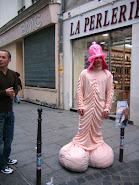
If you have read some of my other postings about the level of sexual harassment on the streets of Cairo, it will probably be no surprise to hear that Egyptian men love to hold their crotches. I only wish that this sight was as attractive as the picture I have added to accompany this posting...
When you are walking the streets, you are confronted with man after man nursing the contents of his crotch area. Every now and again, these men jiggle said contents around, or give them a good scratch. Particularly delightful is when you are in a taxi, and so are at eye-level with said crotches. You turn to look at the morning light over the Nile, and you are confronted instead with a policeman's hand firmly planted on his genitals. It's such a beautiful way to start the day... (and, in fact, was the way I started this Halloween morning).
Monday, 29 October 2007
Female Sexuality... part I
 I have been thinking a great deal about many universal, age-old topics as I tramp the streets of Cairo. One of these topics is “female sexuality”… who hasn’t written or thought about this?? Living in Cairo, I am experiencing my sexuality in a completely new way. There are many elements of the society here that want me to regard my sexuality as a dangerous and unwelcome force that I need to keep well hidden. Because this is a male-dominated culture, with men crowding the public spaces, my sexuality is seen as a source of public disorder. Men, it seems, are naturally sexual animals and so it is the duty of women to prevent the men from becoming too excited. Yesterday, I wore a t-shirt that was a little more low-cut than usual. No, you could not see a hint of my breasts. But it also wasn’t all the way up to my neck. The hissing from men doubled or trebled. And numerous women also looked at me and my collarbones with disgust. Otherwise, I was wearing a long skirt down to my ankles and my hair was tied back. I wasn’t wearing makeup.
Yes… I know that I am in a foreign culture with strong religious beliefs and, as a visitor, I should show respect for Islamic customs. I wouldn’t wear a short skirt and tank top. And I understand and respect the religious convictions of many people here. But my perspective is not religious because, well, I am not religious. And I can see clearly how sexuality is being used as a source of repression and how, in many ways, women are the more powerful members of society because they are capable of ‘entrancing’ men with their bodies. But because of the male physical strength, the men have taken over the majority of societies in the world and women are forced to ‘regulate’ themselves so that the poor men can cope.
Today I am reading an article about how the Taliban controlled women and the private sphere in Afghanistan. The autobiography of one Afghan woman recounts how: “Women were not allowed to laugh or even speak loudly, because this risked sexually exciting males. High heels were banned because their sound was also declared provocative. Makeup and nail varnish were banned. Women who failed to respect such edicts would be beaten, whipped, or stoned to death.” (From Juan Cole, “The Taliban, Women, and the Hegelian Private Sphere,” 70 Social Research 3 (Fall 2003).)
The Taliban was a particularly oppressive regime with shockingly anachronistic interpretations of Islam. But I can feel the same type of attitude here: that women need to ensure that they are in no way provocative, in order to save the poor men from their sexual urges. On my better days, I feel sorry for the men on the street and pity their need to hiss at me. It’s a pathetic attempt to seem ‘manly.’ On the harder days, I begin to feel their aggressive shouts and stares get under my skin and undermine my strength. Last night, after walking the streets in my shockingly provocative t-shirt (with sleeves and just below the collar-bone), I decided to head to the all-women’s section of the gym and avoid any male attention. Constantly pushing against the male assertions of dominance can get tiring and I needed a few hours to feel comfortable with my body and not feel judged or sexually threatening. But these all-female rooms shouldn’t have to exist… it should be the men who are made to regulate their bodies and potential sexual urges. And it should be the men who are made to feel embarrassed and ashamed if they find themselves incapable of controlling their excitement at the sight of a woman’s body.
Sunday, 28 October 2007
Egypt's media defy Mubarak at their peril

An article from the Chicago Tribune describes the extent to which freedom of expression is being repressed in Egypt. The government is cracking down on any journalists (including bloggers) who are critical of Mubarak's regime. One major target has been Ibrahim Eissa, editor of the Al-Dustour newspaper. He reported in August of this year that President Mubarak (pictured opposite) was unwell, and rumours quickly spread that the president had died. The Egyptian government wasn't too happy about this!
The article is available at http://www.chicagotribune.com/services/newspaper/printedition/monday/chi-egypt_slyoct15,0,7285323.story
Eissa seems to be keeping his humour going. He wrote that he was pleased to hear that you could take his i-pod into prison with him:
"I've found out that I'm allowed to take my iPod," he said cheerfully. "This is progress in the Mubarak era. Yes, they do torture you in your cell, but they allow you to listen to your iPod!"
The article is available at http://www.chicagotribune.com/services/newspaper/printedition/monday/chi-egypt_slyoct15,0,7285323.story
Eissa seems to be keeping his humour going. He wrote that he was pleased to hear that you could take his i-pod into prison with him:
"I've found out that I'm allowed to take my iPod," he said cheerfully. "This is progress in the Mubarak era. Yes, they do torture you in your cell, but they allow you to listen to your iPod!"
Friday, 26 October 2007
On why my lungs are feeling so challenged....

"CAIRO, Oct 19 (IPS/IFEJ) - Air pollution is so bad in Cairo that living in the sprawling city of 18 million residents is said to be akin to smoking 20 cigarettes a day. According to the World Health Organisation, the average Cairene ingests more than 20 times the acceptable level of air pollution a day.A 2002 World Bank report estimates that pollution causes 2.42 billion dollars w orth of environmental damage each year, about five percent of Egypt's annual gross domestic product. Industry is to blame, in part, the worst offenders being factories that burn mazot for power. Mazot is the heavy oil left over after more valuable fuel products have been extracted from crude oil; when burnt, it emits substantial amounts of the greenhouse gases said to cause global warming. The Ministry of the Environment continues to promise new measures to hold industry culprits accountable for air pollution, but has failed to put teeth into enforcement."
http://www.ipsnews.net/news.asp?idnews=39730
 orth of environmental damage each year, about five percent of Egypt's annual gross domestic product. Industry is to blame, in part, the worst offenders being factories that burn mazot for power. Mazot is the heavy oil left over after more valuable fuel products have been extracted from crude oil; when burnt, it emits substantial amounts of the greenhouse gases said to cause global warming. The Ministry of the Environment continues to promise new measures to hold industry culprits accountable for air pollution, but has failed to put teeth into enforcement."
http://www.ipsnews.net/news.asp?idnews=39730
Tuesday, 23 October 2007
"The Lost Boys of Cairo", Caroline Moorehead
The Prologue to Caroline Moorehead's "Human Cargo" is called "The Lost Boys of Cairo." It documents her interactions with mainly Liberian refugees who are hiding in Cairo. It is a powerful piece of writing, with incredible snapshots of the stories of individuals who have lost everything and whose future is generally bleak:
"Fear, memory, expectations, endlessly deferred, rule in the quicksands of Cairo's refugee world. Psychiatrists say that it is important for peace of mind to live in the present, to come to terms with daily existence, and neither brood about the past nor attach too much meaning to the future; but the refugees trapped in Cairo today, haunted by terrifying memories of loss and savagery, seduced by a longing for a world they perceive as stable and fulfilling, cannot accept the present. Cairo is a prison sentence, to be endured because there is no option. They simply wait...
Cairo is not just one of the most polluted cities in the world; it is dirty, intensely overcrowded, broken down and full of rubble, with roads built up on legs above other roads in an attempt to dispel the traffic jams that paralyse the city for all the day and most of the night. Occasionally, between the brick and the cement, you catch glimpses of filigreed minarets, delicately carved porticoes and arcades, stately facades and the traces of sumptuous courtyards, earlier Cairos of the Islamic mastercrafstmen and Coptic merchants, when the city was a splendid place of pleasure garden and cool palaces, civil servants in their red fezzes strolled along tree-lined avenues and visitors drank sherbet in famous tearooms. It is the utterly derelict nature of the city today that partly makes possible its absorption of so many refugees - 200,000? 500,000? No one can say for sure. Around the city's edges, entrepreneurs keep constructing identical breeze-block buildings in ever-widening circles, leaving the top floor unfinished so that other floors can be added year by year. From the top of the buildings along the Nile, on the rare moments when the smog evaporates and the setting sun lights up the horizon, you can see the Pyramids of Giza, framed by the jagged edges of yet more unfinished blocks. Wherever the buildings are most derelict, the electicity supplies most sporadic, the water least reliable, there the refugees live." (pages 8-9)
"Fear, memory, expectations, endlessly deferred, rule in the quicksands of Cairo's refugee world. Psychiatrists say that it is important for peace of mind to live in the present, to come to terms with daily existence, and neither brood about the past nor attach too much meaning to the future; but the refugees trapped in Cairo today, haunted by terrifying memories of loss and savagery, seduced by a longing for a world they perceive as stable and fulfilling, cannot accept the present. Cairo is a prison sentence, to be endured because there is no option. They simply wait...
Cairo is not just one of the most polluted cities in the world; it is dirty, intensely overcrowded, broken down and full of rubble, with roads built up on legs above other roads in an attempt to dispel the traffic jams that paralyse the city for all the day and most of the night. Occasionally, between the brick and the cement, you catch glimpses of filigreed minarets, delicately carved porticoes and arcades, stately facades and the traces of sumptuous courtyards, earlier Cairos of the Islamic mastercrafstmen and Coptic merchants, when the city was a splendid place of pleasure garden and cool palaces, civil servants in their red fezzes strolled along tree-lined avenues and visitors drank sherbet in famous tearooms. It is the utterly derelict nature of the city today that partly makes possible its absorption of so many refugees - 200,000? 500,000? No one can say for sure. Around the city's edges, entrepreneurs keep constructing identical breeze-block buildings in ever-widening circles, leaving the top floor unfinished so that other floors can be added year by year. From the top of the buildings along the Nile, on the rare moments when the smog evaporates and the setting sun lights up the horizon, you can see the Pyramids of Giza, framed by the jagged edges of yet more unfinished blocks. Wherever the buildings are most derelict, the electicity supplies most sporadic, the water least reliable, there the refugees live." (pages 8-9)
Sunday, 21 October 2007
Cairo Metro
The metro in Cairo was a wonderfully pleasant surprise – it beats London and New York for cleanliness and speed. And it only costs 1 Egyptian pound (around 10 pence in the UK..) What made the ride so pleasant was the fact that there is a women’s-only carriage at the front of the train. Finally I could stare at people to my heart’s content and not get immediately propositioned for sex…!! What a great thirty minutes of freedom!
The carriage was full of women and children dressed in all sorts of colours and to various degrees of conservatism. There were women dressed from head to toe in black, with sheets of material covering their whole body, with only a small slit for the eyes. These women even wear gloves… they made me feel extra hot as I stood in my trousers and shirt and felt beads of sweat trickling down my back.
The majority of women, however, were in a regular hijab – a headscarf that covers all the hair and frames the face. Some of these scarves were bright, decorated in sequins and small beads. Others were very plain and somber. The majority of younger women wearing the niqab had on jeans and tight tops—though the sleeves almost uniformly went to the wrist (a favourite style is a long-sleeved top with a little tank top over the top). The older women, however, tended to be wearing loose tops and long ground-length skirts.
One woman in particular stood out: a strikingly-beautiful young woman in an aquamarine scarf draped only loosely around her head. She was much darker than the other women and almost certainly wasn’t Egyptian. Her hair was in tight braids and her silver jewelry shone against her skin. Egypt is full of refugees fleeing from the numerous civil wars further south in Africa. The majority of cleaners hired by Westerners seem to be from African countries south of Egypt: Somalia, Sudan, Liberia, Eritrea (see AMERA, an NGO working in Cairo with refugees, link on the RHS of this blog). I wondered about her story and whether she felt as much of a foreigner as I did, standing amongst chattering families and schoolchildren trying to finish their homework.
Generally, I think it will be hard to meet Egyptian women. Everywhere I go, there are crowds of men, but very few women. But I had so many questions I wanted to ask the women on that carriage: How do they deal with the aggressive Egyptian men? How do they feel when they are covered beneath so many layers of hot material? What do they think when they look at me with my t-shirt and uncovered head? What do they think of President Mubarak? If they had one wish, what would it be?
The carriage was full of women and children dressed in all sorts of colours and to various degrees of conservatism. There were women dressed from head to toe in black, with sheets of material covering their whole body, with only a small slit for the eyes. These women even wear gloves… they made me feel extra hot as I stood in my trousers and shirt and felt beads of sweat trickling down my back.
The majority of women, however, were in a regular hijab – a headscarf that covers all the hair and frames the face. Some of these scarves were bright, decorated in sequins and small beads. Others were very plain and somber. The majority of younger women wearing the niqab had on jeans and tight tops—though the sleeves almost uniformly went to the wrist (a favourite style is a long-sleeved top with a little tank top over the top). The older women, however, tended to be wearing loose tops and long ground-length skirts.
One woman in particular stood out: a strikingly-beautiful young woman in an aquamarine scarf draped only loosely around her head. She was much darker than the other women and almost certainly wasn’t Egyptian. Her hair was in tight braids and her silver jewelry shone against her skin. Egypt is full of refugees fleeing from the numerous civil wars further south in Africa. The majority of cleaners hired by Westerners seem to be from African countries south of Egypt: Somalia, Sudan, Liberia, Eritrea (see AMERA, an NGO working in Cairo with refugees, link on the RHS of this blog). I wondered about her story and whether she felt as much of a foreigner as I did, standing amongst chattering families and schoolchildren trying to finish their homework.
Generally, I think it will be hard to meet Egyptian women. Everywhere I go, there are crowds of men, but very few women. But I had so many questions I wanted to ask the women on that carriage: How do they deal with the aggressive Egyptian men? How do they feel when they are covered beneath so many layers of hot material? What do they think when they look at me with my t-shirt and uncovered head? What do they think of President Mubarak? If they had one wish, what would it be?
Mobile phone stalkers - an Egyptian male obsession

Egyptian men are not content with merely cat-calling and hissing. They also, I realise, all make sure that they have cameras on their mobile phones so that they can store images of "Western hotties." I dread to think what use these fuzzy pictures are being put to... eugh. I'm feeling more and more committed to "the right to privacy" as each day passes...
bellydancers, dwarfs and a strange Egyptian night...


I'm slowly (or maybe quickly!) being introduced to the strange intricacies of Cairo nightlife. On Friday, I began the night at the lovely rooftop Nile Hilton bar, "Mojitos". This is a new bar with an incredible view over Cairo. And there are plenty of Egyptian women there, dancing away in skimpy outfits. Halleluiah!
But the Nile Hilton was not where I was able to discover the truly bizarre, seedy side of Cairo nightlife... That awaited me in full form in a bellydancing club (read whore-house) that we went to after Mojitos. Saying goodbye to the glitz and glamour of the Hilton, we meandered through the streets of Cairo to a small brown door with very few markings. I was expecting a dimly-lit, smokey dive with lots of little booths. Think again. Smokey it was. But it was more like a greasy-spoon cafe, with bright neon lighting and small tables pushed up against the wall. The place (of course!) was crowded with men. As we stepped into the place, hands went to pockets and the mobile phone camera sessions began (see my posting on this Egyptian obsession).
We sat down at a table next to a group that included a sheesha-chain smoker and a dwarf. Yes, dwarf. This small guy was attracting the most attention from the bellydancers and they kept dragging him to his feet so he could shake his booty for the rest of us... very very weird. The women were generally dressed in somewhat boring tight jean/ low top combinations. But the makeup on every single woman's face was fit for a drag queen. Then the drag queen herself emerged (though I think she was female - if not, then I praise the surgeon who managed to construct those breasts and hips and stomach). She wiggled her way, stomach leading, over to our table, allowed us to stuff handfulls of notes into her cleavage, and then strutted her stuff. I was mesmerized. Cristina, my roommate, got up on her feet and did a wonderful dance-off with the queen. But, as the dwarf got in on the action and the bellydancer's bum wiggled in curious treble-beat time... the Egyptians definitely won the night. Multiple photos of my slightly horror-stuck face are probably stored in a number of Egyptian mobile phones around Cairo. I just hope that they haven't made it yet to any seedy porn sites...
But the Nile Hilton was not where I was able to discover the truly bizarre, seedy side of Cairo nightlife... That awaited me in full form in a bellydancing club (read whore-house) that we went to after Mojitos. Saying goodbye to the glitz and glamour of the Hilton, we meandered through the streets of Cairo to a small brown door with very few markings. I was expecting a dimly-lit, smokey dive with lots of little booths. Think again. Smokey it was. But it was more like a greasy-spoon cafe, with bright neon lighting and small tables pushed up against the wall. The place (of course!) was crowded with men. As we stepped into the place, hands went to pockets and the mobile phone camera sessions began (see my posting on this Egyptian obsession).
We sat down at a table next to a group that included a sheesha-chain smoker and a dwarf. Yes, dwarf. This small guy was attracting the most attention from the bellydancers and they kept dragging him to his feet so he could shake his booty for the rest of us... very very weird. The women were generally dressed in somewhat boring tight jean/ low top combinations. But the makeup on every single woman's face was fit for a drag queen. Then the drag queen herself emerged (though I think she was female - if not, then I praise the surgeon who managed to construct those breasts and hips and stomach). She wiggled her way, stomach leading, over to our table, allowed us to stuff handfulls of notes into her cleavage, and then strutted her stuff. I was mesmerized. Cristina, my roommate, got up on her feet and did a wonderful dance-off with the queen. But, as the dwarf got in on the action and the bellydancer's bum wiggled in curious treble-beat time... the Egyptians definitely won the night. Multiple photos of my slightly horror-stuck face are probably stored in a number of Egyptian mobile phones around Cairo. I just hope that they haven't made it yet to any seedy porn sites...
Friday, 12 October 2007
Harassment on the streets...


Should I dress like the women on the billboards or the women in the street??
A number of people have asked me what I'm wearing here in Egypt... I did consider wearing a veil before I flew over here. I'd heard that the harassment of Western women who walk on the streets is getting worse and wearing a headscarf can minimize this nuisance. But none of the Western women I've talked to here wear anything on their head. Most just wear what they'd wear back at home (though you're not going to see mini skirts/ boob tubes etc!) I'm definitely leaning more to the conservative side.. I try to cover my legs and most of my arms, despite the fact that it is so hot and sticky. I'm also trying to avoid anything that hugs my figure. You become extremely aware of any VPL possibilites when you know you're being stared at all the time and thought of as a semi-prostitute...
Overall the harassment is a complete pain. Men are continually hissing, making comments about 'sex/ riding me (ie sex)', clicking their tongue... I've mastered the skill of staring at some nondistinct point in the sky or around knee height. I'm also wearing my big sunglasses as much as possible so I don't accidentally catch a man's eye. It's tiring and a real nuisance. It's horrible to be objectified as a sex object - any feminist instincts I have are being doubled by the minute ;-)
Subscribe to:
Posts (Atom)